
Vibe Token
A Market-Priced Contribution System for Small Software
Token systems introduced sound economic primitives: programmable ownership, automated distribution, permissionless participation. What failed was not the mechanism but its deployment. Speculation displaced contribution. Financial games crowded out builders and referrers.
Vibe Token is designed for small, high-margin software businesses, the kind now cheap to create but still hard to distribute. It gives early contributors a direct stake in future revenue.
The Six Rules
P = k × √Stokens = floor(α × dR ÷ P)payout = (α × dR) ÷ Sexit_value = tokens × PThe Problem
Software creation costs have collapsed. A developer with language models can ship a working product in hours. Distribution remains expensive: not in money, but in attention and trust. The people who spread software early create real value. They rarely capture it.
Traditional equity solves this for venture-scale companies. Vibe Token solves it for everything else: the micro-SaaS, the tool for a niche community, the app that serves six friends for one summer. Human-scale software deserves human-scale economics.
The Commitment
The founder specifies α (revenue share) at launch. Once set, it cannot be changed.
Typically 10-30%. No renegotiation, no gradual reduction, no bait-and-switch.
Variables
R cumulative revenue (lifetime)· dR new revenue event· α revenue share (founder-specified)· S circulating supply (issued only)· Smin minimum supply floor (1,000)· P token price· k pricing constant
Token Pricing
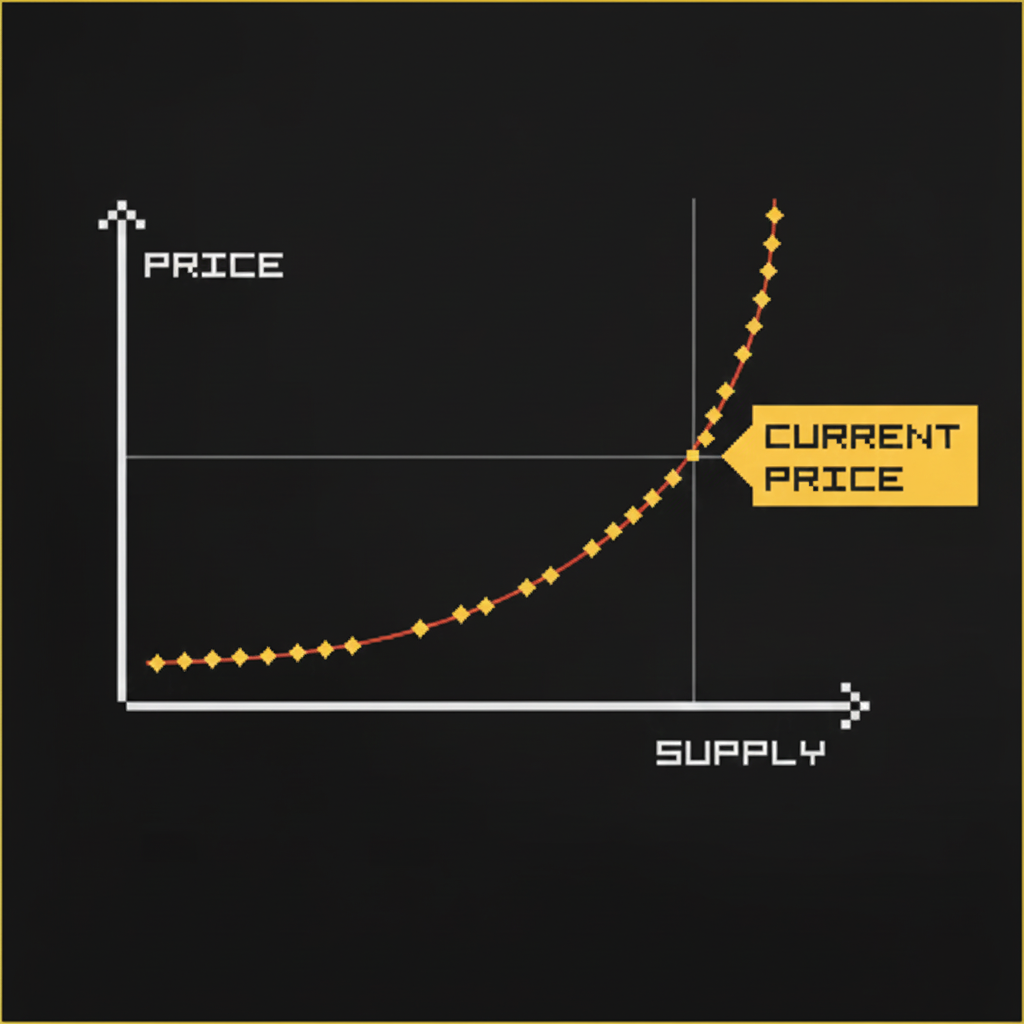
P = k × √S
Price is determined by circulating supply. When tokens are minted (through referral earnings), supply increases and price rises. When tokens are burned (through exits), supply decreases and price falls. The square root dampens volatility: doubling supply increases price by ~41%, not 100%.
Choosing k (Pricing Constant)
k = max(MRR ÷ 1,000,000, 0.005)
The pricing constant k anchors token value to business scale. Set k proportional to your monthly recurring revenue, with a minimum floor. This keeps grant values reasonable relative to what the business can actually pay out.
The floor ensures viable token economics for micro businesses. If k is too high, grants become worth more than the business can pay out. Rule of thumb: initial grants should total less than 50% of expected year-one distributions.
Pre-mint Treasury
Pre-mint creates a treasury pool. These tokens are inert: they do not participate in distributions until the founder grants them to contributors. The founder's compensation is retained revenue (1-α), not tokens.
Before any revenue exists, founders need tokens to distribute. Pre-mint solves this cold-start problem: give tokens to the influencer who tweets your launch, the friend who refers customers, the beta tester who finds bugs.
Token Earning
tokens = floor(α × dR ÷ P)
Tokens are earned, not purchased. When someone refers a customer who generates revenue, the referrer earns tokens. Tokens are whole integers; remainders are discarded.
Why no direct purchases? Purchasing tokens with money triggers securities law. Earning tokens through marketing, referrals, and sales compensates labor rather than selling investment contracts.
Revenue Distribution
D = α × dR
payout = D ÷ S
Each revenue event adds the founder's share (α) to a distribution pool. The system divides this pool among issued token holders proportionally. Treasury tokens do not participate. Pending exits receive payment first.
Token Exit
exit_value = tokens × P
Holders can exit any number of tokens at any time—one token, their entire stake, or anything in between. The system calculates exit value at current price.
- Burning tokens decreases supply
- Holder joins the exit queue
- Future distributions pay exit value
- Partial exits let holders take liquidity while keeping exposure
Exit Queue
Exiting holders enter a queue and are paid from future distributions, first-in-first-out. When the queue clears, full distributions resume.
The system needs no reserve pool. Future revenue funds exits. If the business stops generating revenue, the queue stalls. That's honest: tokens were always claims on future revenue.
System Properties
Closing
New software architecture makes this possible. When applications run on user devices, with data synced rather than centralized, operational costs collapse. One developer can serve thousands of users. Communities can have their own isolated worlds: their own databases, their own economies, their own fates.
Vibe Token is infrastructure for this future. Not a movement, not a platform, not a promise. A mechanism: connect contribution to revenue, let the math handle distribution, see what people build when early support finally means something.
View Simulations